By Steve McKichan /
This topic is designed to illustrate the importance of closure discipline.
To define this you have to understand that every save movement a goalie makes involves an extension movement widening their coverage but creating holes or compacting their coverage closing holes.
The obvious key to success here is recognizing when to select either option and when to maintain the option you selected.
I think a few examples will clarify this discussion.
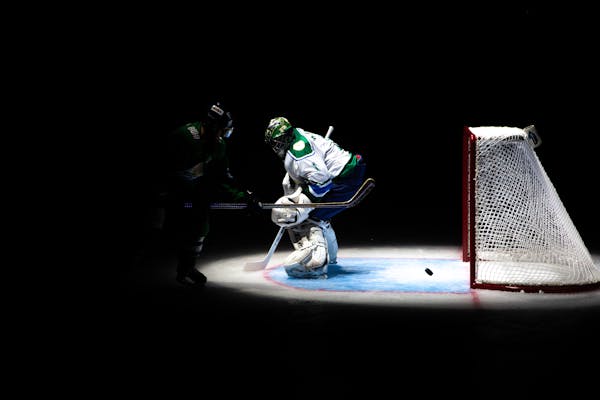
On a recent goal, the goalie made a great butterfly save on a hard shot from the slot through traffic. The save left a rebound directly in front (three-feet). The goalie made the right decision to stay down but inexplicably immediately extended his butterfly into a massive wide flare and created separation in his thighs. Although he had good stick discipline, the puck got through his thighs on the whack rebound. (The whack rebound is simply a rebound attempt with no direction only speed of release.)
Depth wise he was at the top of the crease so the reaction of creating unneeded width opened a hole that the puck found.
The age-old advice of nothing through you or under you applies here.
You must develop the ability to resist the urge to open and extend here.
To develop this you can set up a controlled drill that will also illustrate the low percentage a player has when he can’t place a whack rebound through you.
A goalie I coached named Ron Vogel always exploded open too much.
As a controlled drill, I place a strong strap connecting his knees that prevented his thighs from separating more than a few inches.
We had hard point shots fired that still allowed him to do a tight medium flare butterfly with no thigh or knee gap.
The rebounder was allowed only to immediately whack at any rebound. He wasn’t allowed to pull and shelf.
On 15 pucks he scored only one whack rebound. Ronny simply stayed down and kept a flare that corresponded to his depth.
Remember that the width of your flare should always match your depth. If you get caught on the goal line you need wide flare and if you are a couple feet out on a wing slapper, you need a very small flare. |