By Andrew Chong, Editor, with Danny Beck, resident Ranter /
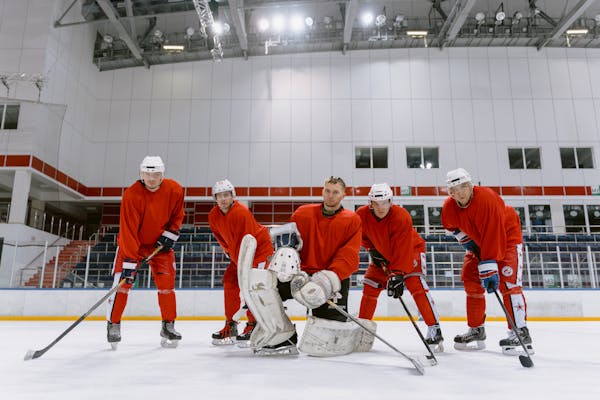
With the Chicago Blackhawks and Philadelphia Flyers both reaching the Stanley Cup Finals on the backs of goaltenders who make less than $1 million per year, will the rest of the NHL follow suit?
Doug Wilson, GM of the San Jose Sharks, recently announced that he would not be re-signing Evgeni Nabokov.
“If you look at the trends in this league the last four or five years in particular and the dollars that are dedicated to that position—if you’re dedicating $5 or $6 million, that’s coming out of somewhere else,” said Wilson. “The goaltending market is very deep. There’s lots of goalies that are out there that you can supplement or build a tandem with what you have.”
To spend or not to spend; let the debate begin...
How much is too much?
AC: Given the chance to sign a guy like Ryan Miller for $6 million-plus, I am jumping on it. At the Olympics, Miller single-handedly earned a round-robin win over Canada and proceeded to carry Team USA on his back to within an overtime goal of gold. A top-end goaltender can still drastically impact results.
DB: Clearly, big-money goalies don’t carry teams anymore. All NHL goalies are separated by so little that you don’t need that big guy anymore. Teams must have solid D-men at the #5 and #6 holes and the third and even fourth line must contribute. The winning and losing finalists since the lockout have had great six-man D crews and their third lines were skilled, fast and could punish – and that doesn’t come cheap.
Should teams copy Chicago?
AC: To follow the Chicago model is to be a bad team for a decade, draft high, and then bank on your young stars to play above their pay grade. Chicago’s had the playoff MVP (Toews), the overtime hero (Kane), and the Norris trophy winner (Keith) for a combined cap-hit of $8 million—$250,000 less than Eric Staal. Goalies have not become less valuable in the salary cap era. Rather, entry-level deals and bargain contracts have become much more important.
DB: I am not sure one would want to copy that model. I also think it would be impossible to do since a fair bit of luck had to occur for some of those players to be in the same age group at the right time. Plus, the model that they followed (i.e. dumb GM that forgot to meet offer-sheet deadlines, last summer to Barker and Versteeg) has caused them to be forced to move Barker, Byfuglien, Sopel, Eager and more to come. Not to mention, stupid moves for Hossa (the central error being his length of contract), Campbell and Huet. The love-in with Chicago should be tempered.
What does history say?
AC: Pittsburgh won the Cup in 2009 with a $5 million goalie (Fleury). Anaheim won the cup in 2007 with a $3.9 million goalie (Giguere). In 2008, Chris Osgood made $850,000 en route to backstopping the Red Wings to a Cup, but he had incredibly well-priced help with guys like Zetterberg ($2.65 million) and Franzen ($942,000) on bargain deals; not to mention the best defenceman of the last decade in Nicklas Lidstrom. Winning a cup in the salary cap era is not about finding a cheap goaltender. It’s about managing your money—and getting a little lucky (i.e. Zetterberg being drafted 210th overall).
DB: Like I said, history dictates that the money needs to be spread around to provide quality depth at all positions. Teams must also have at least three forwards and two D that provide quality minutes that are on entry-level deals. You just can’t have all veterans doing the same or less for more.
Where are the bargains?
AC: Every team wants a solid goaltender that can take them on a deep playoff run. But these guys don’t grow on trees. The goalies you’d expect to be available via free agency are available: unproven young guys, aging former studs, and inconsistent journeymen. Give me a $6 million Kipper, Lu, or Lundqvist any day of the week over a discounted Turco, Theodore, or Toskala.
DB: Follow the money. Pay a guy like Chris Mason, Dan Ellis or Craig Anderson $2 to $3 million per and use the other $4 million to get a solid third-line centre and a fifth D-man that can be a third D-man when injuries follow.
NHL GOALIE CAP-HITS:
25 HIGHEST (2010/11 cap-hit)
1. Henrik Lundqvist NYR $6.875
2. Cam Ward CAR $6.300
3. Ryan Miller BUF $6.250
4. J.S. Giguere TOR $6.000
5. Niklas Backstrom MIN $6.000
6. Miikka Kiprusoff CGY $5.833
7. Tomas Voukoun FLA $5.700
8. Cristobal Huet CHI $5.625
9. Roberto Luongo VAN $5.333
10. Martin Brodeur NJD $5.200
11. Tim Thomas BOS $5.000
12. M.A. Fleury PIT $5.000
13. Rick DiPietro NYI $4.500
14. Jonas Hiller ANA $4.500
15. Ilya Bryzgalov PHX $4.250
16. Pascal Leclaire OTT $3.800
17. N. Khabibulin EDM $3.750
18. Kari Lehtonen DAL $3.550
19. Pekka Rinne NAS $3.400
20. Dwayne Roloson NYI $2.500
21. Mike Smith TBL $2.200
22. Craig Anderson COL $1.812
23. Jonathan Quick LAK $1.800
24. Chris Osgood DET $1.417
25. Jonas Gustavsson TOR $1.350
10 LOWEST (2010/11 cap-hit)
1. Curtis McElhinney ANA $0.535
2. Thomas Greiss SJS $0.550
3. Brent Johnson PIT $0.600
4. Jimmy Howard DET $0.717
5. Erik Ersberg LAK $0.750
6. Semyon Varlamov WAS $0.822
7. Brian Elliot OTT $0.850
8. Cory Schneider VAN $0.900
9. Steve Mason CLB $0.905
10. Brian Boucher PHI $0.925
FREE AGENTS (2009/10 cap-hit)
*denotes restricted free agent
Marty Turco $5.700
Evgeni Nabokov $5.375
Jose Theodore $5.375
Vesa Toskala $4.000
Chris Mason $3.000
Carey Price* $2.200
Dan Ellis $1.750
Ray Emery $1.500
Antti Niemi* $0.827 |