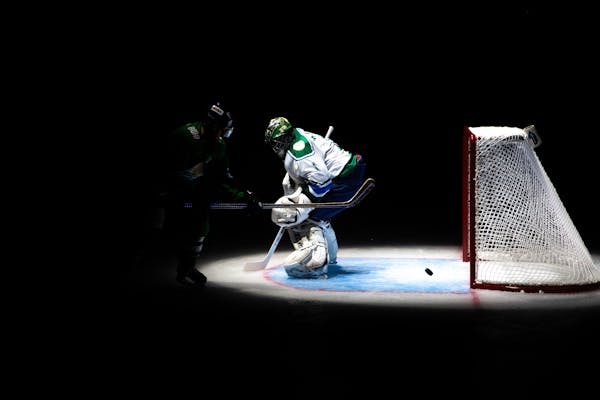
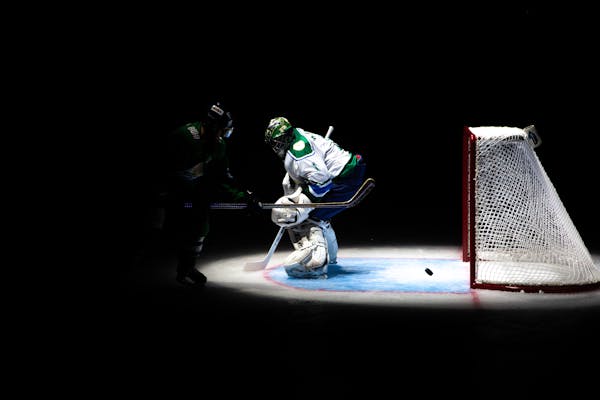
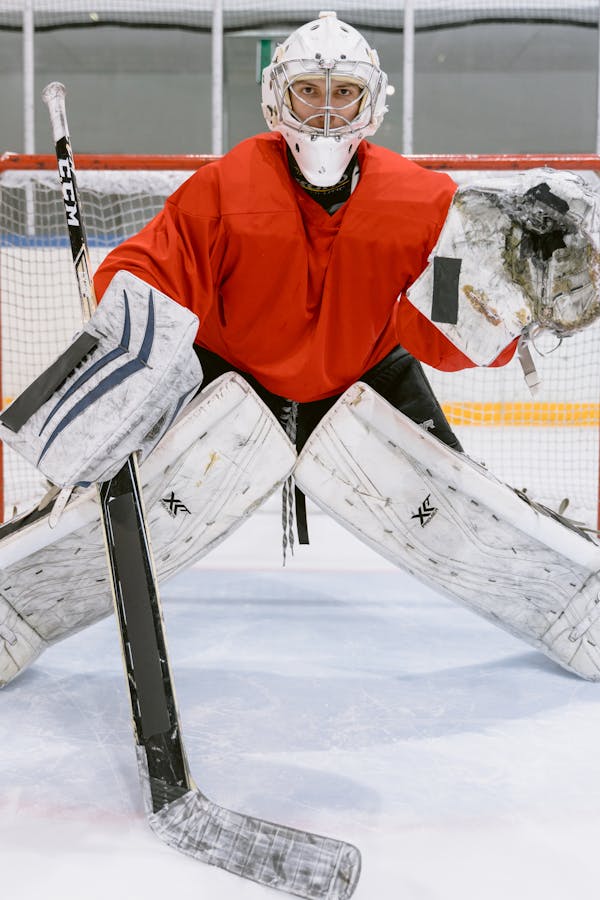
In the last article I briefly discussed one of the issues that some parents and coaches have with the butterfly style. That complaint is that too many goals are scored in the upper part of the net. However, I pointed out that for every goal given up in the upper part of the net, the goalie probably made a dozen saves that he could not make with the stand up style.
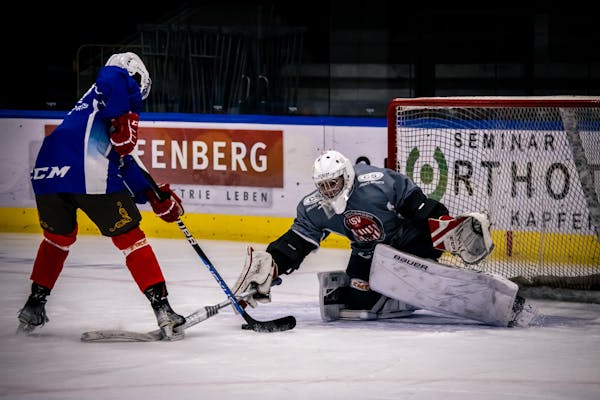
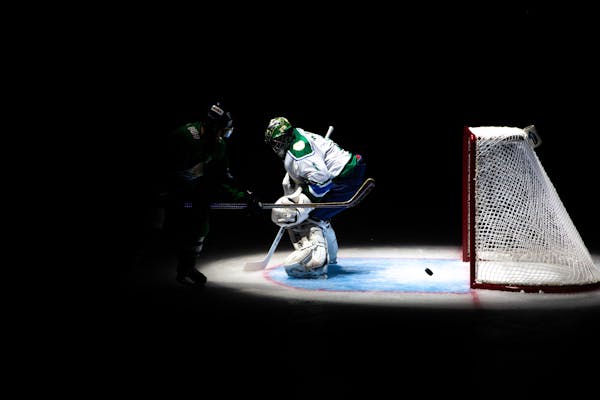
The same kind of thinking can apply to reboud control in the butterfly position. It is true that sometimes it appears that the goalie does not control his rebounds very well. For instance, on a low shot taken from the perimeter to the the far side of the net, the rebound almost automatically ends up in the slot area. As previously explained, by going down in the butterfly the goalie is simply playing a percentage game. He wants to make sure that he makes the first save. If the goalie tries to control his rebound by standing up or moving his stick and legs, it will result in him not being as efficient on first shots.
A good example of this is the use of the stick. In the butterfly position, the blade of the stick has to be inclined. When the puck hits the blade, it either jumps up in the goalie’s belly or it bounces off in the corners. However, if the goalie moves his stick to the side, his body will not be there to stop the rebound.
The most important factor with the butterfly style is not so much rebound control, but anticipation. The goalie has to know where his rebounds will end up going so he can quickly get up and get to them. In order to anticipate where the rebound will end up going, the goalie has to minimize his movments. By moving his stick and pads, he will constantly change the direction of his rebounds making it harder on himself and on his defencemen to know where to look for the puck once the first save has been made.
Rebound recovery from the butterfly
There are two ways that the goalie can use to get to a rebound after he has made a save in the butterfly. He can get back on his feet and T-push to the rebound. This kind of movement is called a butterfly recovery. The goalie can also choose to stay down and slide towards the rebound. This kind of movement is often referred to as an inside edge push. The position of the shooter in relation to the puck determines what movement the goalie will use. If the shooter is far from the rebound, the goalie has time to get back on his feet. If the shooter is very close to the puck, the goalie will not have time to get up and would have to slide over.
Four steps of Butterfly Recovery
The first step is head and shoulder control. The goalie has to keep his eyes on the puck as it’s going off his body or pads. By doing so, the head and shoulders will automatically rotate in the direction of the puck.
The second step is bringing the inside leg under the body. This will allow the lower part of the body to rotate in the direction of the puck. More importantly, it will allow for the back leg to get in position for the recovery. When the goalie wants to execute a butterfly recovery he has to get his back leg up first because that is the power leg. If the goalie gets his lead leg up first, he will not be able to push right away. Only after his back leg is up will he be able to push towards the puck. Thus, if the goalie wants to save time, he has to get his back leg up first.
The third step is bringing the back leg up. Before the goalie brings his back leg up, he has to make sure that his skate is facing in the direction he wants to go. For instance, if the rebound goes across the ice, the goalie will have to push slightly back in his crease to get to the other face off dot (See article on the 7 zones). In order for the goalie to be able to push slightly back in his crease, his power has to be taking him back. The only way that this can happen is by having his back skate facing back. If the goalie’s skate is not facing back he will not be able to efficiently push towards the rebound. So before bringing the back leg up, the goalie has to bring his back skate across his body.
The fouth step is the execution of the push itself. To initiate the push the goalie has to bring his lead leg up. In order to execute a powerful push towards the puck, it is essential that the goalie steps towards the puck. Thus, as he is getting his lead skate up the goalie wants to make sure that he is lifting it off the ice and bringing it slighly back under his body. This will allow him to explode towards the puck.
Keep training hard and check back next issue for more of my goalie tips and techniques. And remember…Keep your eye on the puck!!
Eli Wilson is the goaltending coach of the Ottawa Senators and is also president of Calgary’s World Pro Goaltending school.




-WEB-FINAL.gif)