By Dean McIntosh /
The most common complaint heard in discussions concerning minor hockey is, “There just isn’t enough ice time”. This complaint is voiced by administrators, coaches, parents and players alike. It seems, however, that when we compare the number of ice facilities that we have in Canada versus other traditional hockey playing nations it is apparent that this complaint is not necessarily valid. Our challenge is that we have large numbers of users, including those who either are not hockey players or are not under the jurisdiction of the minor hockey association. We need to become much more innovative in our approach to the whole subject of ice utilization.
The Open Ice Summit discussed several issues that have relevance to the subject of practice planning including skill development, practice to game ratio, creativity and thinking skills. Without risking opportunities for our youth to play the game, the challenge is to come up with alternatives to the usual practice / game structure, used by a majority of our minor hockey associations, which will develop skill our players need and allow them to practice more often.
In order to do this, can each practice be shorter and still be effective? What can we do off the ice to compliment on-ice activities, including skill development, in order to make the on-ice practice more efficient? Can our coaches learn to be more organized and prepared as well as plan better in order to improve practices? What can we do to change the connotation that practice is boring and a necessary evil? Can practice be less structured and still effective? Can half-ice practices have a positive impact or are they a waste? What about shared or combined practices? The answers to these questions are definitely positive, as coaches we can implement all of the above ideas to improve player develop, the next step involves implementation. The following are examples of modified practices that provide a great opportunity for skill development.
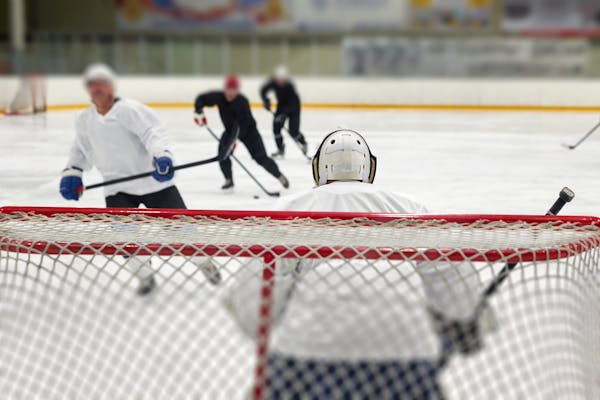
1. Practice two teams together. Treat the players as one big group as in a hockey school, with 30+ kids and 6 – 8 coaches the ice time can be run very efficiently.
2. Invite another team to your full ice practice and vice versa, that way you get more ice time, but no extra cost. Realistically, professional teams run practices with 23 – 25 players everyday, and they are a lot bigger and take up more room than minor hockey players.
3. Practice together for half the practice and then utilize half ice after that. It is a great way to get full ice skating drills in if you need.
4. Ice – Max . This system works by having one team come on the ice by themselves for half an hour having full ice. Then a second team comes on the ice for the second half an hour, thus sharing the ice for the second half hour. Then the first team leaves after the half hour of shared, giving the second team full ice for their second half hour. This enables two teams to utilize 1.5 hours instead of the traditional 2 hours, which over the course of a day or evening, more ice is available.
5. Go watch Midget AAA, Junior or Pro teams warm up before a game. The two full teams on the ice are basically doing two half ice practices. You will see lots of good drills and get some good ideas.
6. Develop practices that teach skills through small area games. These games promote fun and skills develop as each player is given ample opportunity to skate, shoot, pass, handle the puck, check and score. Rule modifications can be made depending on what the coach wants to teach, including individual skills and tactics where players are forced into situations that build read-react abilities (hockey sense). Best of all small area games put players into situations that they cannot handle and creates a real “need to know” mentality amongst them (I need to get better at that, how can I ...). Skill and tactical drills that address deficiencies then become an easy sell – they have relevance for the players and they buy in.
Hockey Canada now has available through Breakaway a half ice / share ice manual. To order call 1-800-667-2242 or go to www.hockeycanada.ca |