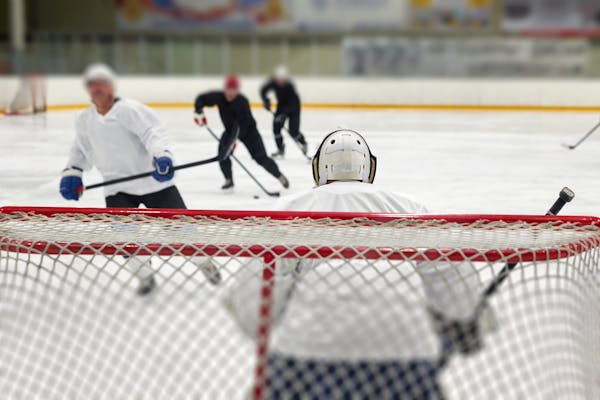
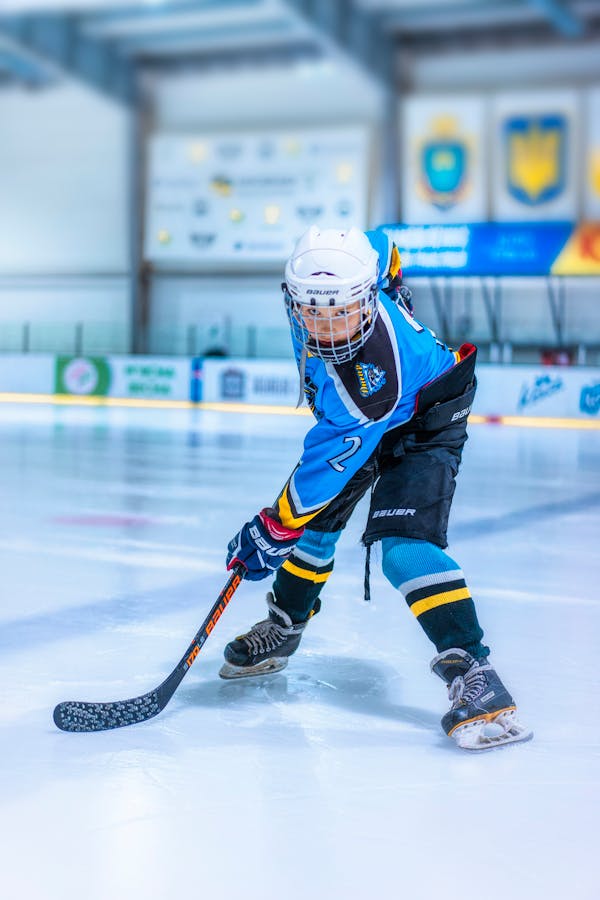
In hockey, speed refers to acceleration and top-end velocity – how fast can a player skate in full flight, on a breakaway, during a breakout pattern or to backcheck and prevent a scoring opportunity.
Relative to a race car, quickness is gears one and two. Coaches refer to first step quickness – exploding from a stationary position which is evident as the first move in a one-on-one tactic such as cutting inside a defender to the slot for a scoring threat.
Quickness is also drawn upon during repetitive fast footwork such as repeated cross-over’s cycling out of the corner.
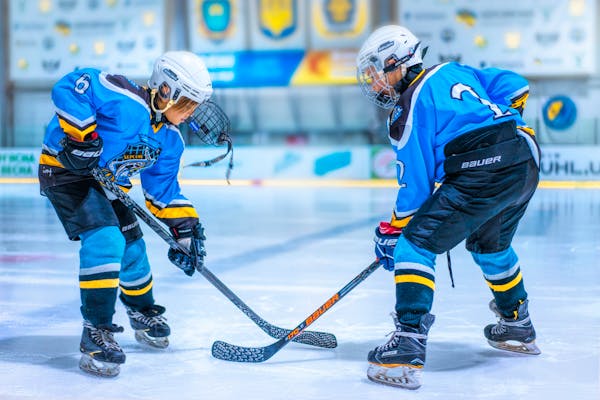
Hockey is a game of one-on-one battles and races for loose pucks.
The ability to initiate movement faster than opponents is critical—teams rarely lose if they are consistently the first to the puck and always right on top of the play.
Shifting gears
A forward in full flight down the wing can cause defencemen to be taxed beyond their abilities by shifting gears with instantaneous adjustments. Rapidly alternating between decelerating and accelerating challenges defensemen to continually read and react to cover the forward.
Flow drills in practice can be cued to include dropping or picking up a gear, on the coaches whistle or when hitting a cone.
In a game, a forward can accelerate to the outside and when the forward sees the defenceman shift his weight to gain speed and prepare to open up to the boards, the forward can then put on the brakes and immediately cut laterally inside to the slot position, leaving the defenceman one move and one gear behind.
The ability to quickly change gears is very effective for throwing off a defender.
Checking
Quickness, combined with strength, is also an ingredient of bodychecking.
To execute bodychecks with the most power and follow through leverage, players have to be able to read the play and quickly move into position for the hit. Then they must quickly lower their body into a power position, and explosively thrust upward, first with the legs and then quickly following through with the arms.
The weight transfer from low to high must be very quick – explosive – to overpower an opponent skating the opposite direction.
Lightning Fast Feet Drills
Hockey players can gain an edge on their competition by improving their foot speed.
When a player sees a breakdown in the play, good reads and quick reaction skills are only one piece of the equation.
They must be able to capitalize on the opportunity with fast feet.
Coaches forever command players to keep their feet moving.
The Two Down, One Back Micro Hurdle Drill (shown in photo) teaches the athlete to move efficiently and change direction quickly, developing fast feet.
In a game with tight 1-1 checking, it is the player who can fire their feet quickly, keep their feet moving, always in action, who will be successful.
Turning over your feet quickly creates space between you and the defender. It allows you to get to the net quickly, and get in position for a scoring chance before being checked. It makes you a threat even when in the corner.
When opponents learn that you have fast feet and are difficult to contain in tight, they will make the mistake of backing off and give you space.
Peter Twist, 11 year NHL Conditioning Coach, is now President of Twist Conditioning Inc that provides franchised Sport Conditioning Centres, hockey training products and home study coach education. www.twistconditioning.com |