By Peter Twist /
High-speed agility is one of the strongest discriminators between star major pro players and stalled minor pro players. Analyze most game-breaking plays and discover that they were created from an explosive tactic – team sports that involve one-on-one confrontations will always be dominated by the quickest. Nowhere is this more evident than in ice hockey where strategies follow a read-react-and-explode pattern.
Smooth, quick, coordinated agility is required to change direction very quickly, effectively and efficiently, while under control and visually aware. An agile hockey player is able to move dynamically but in a position where she remains ready to adjust movements in any direction—responsively. Often, agility is displayed as a series of continuous changes in direction. In fact, agility can be thought of as multi-directional quickness.
Some big defensemen are often incorrectly called “slow” by fans and coaches. These players’ top-end speed is comparable to other players. What they may lack is quickness. However, they succeed because they move so efficiently. They have great mobility and lateral movement—great agility. They may not appear quick or explosive, but their agility allows them to win one-on-ones.
Sometimes veteran defensemen will attribute their success to “experience,” “knowing where to move,” or “positioning,” in lieu of quickness, not even realizing that their ability to move into position or knowing where to go or how to react is agility. Agility is stored motor patterns of complex movements. Each time you repeat a certain movement, it is reinforced and becomes easier to do next time.
From a biomechanical perspective, the 100-metre linear sprint provides a very poor model for teaching hockey acceleration. The rules of specificity training have always been simple. To improve agility, you must train agility. Traditional, linear speed training will build linear top-end sprinting speed. Training for first-step quickness permits you to get your body moving more explosively. But training for linear speed and first step quickness does not translate to multi-directional speed. Games that require stop-and-starts, lateral movement, drop step pivots, crossovers, turns and cycling emphasize the need to train agility and prepare for multi-directional movement.
Deceleration Training
Many hockey training programs are marketed around speed. This is the result of marketing studies because parents have proven to respond to the allure of ‘acceleration training’ and sign up their kids. Research documents that forward linear speed-based training do not transfer to complex agility tasks, which require deceleration and direction change mechanics. Certainly, starting fast and going fast are important and are an ingredient to hockey success, but not the only factor required. The skating recipe needs several ingredients – acceleration, top-end speed, first step quickness, ability to shift gears, reactivity, agility and most important—deceleration training.
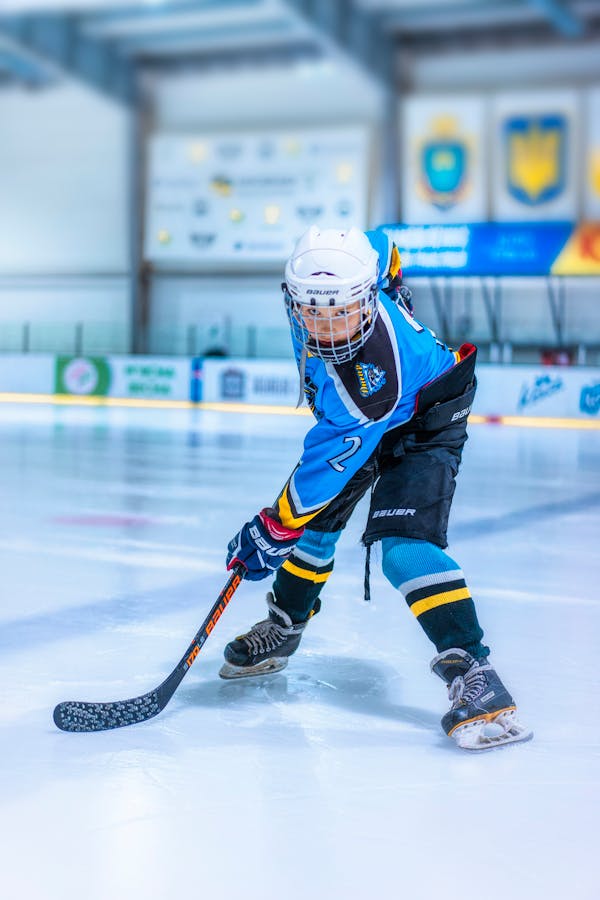
Braking skills can be sharpened to stop more abruptly to allow more sudden direction change and to fire through multi directional agility patterns more aggressively. The 2 BOSU Crossover and Stick Drill (shown in photo) is a great drill to improve hip mobility, crossover stride power, multi-directional movement skills and landing stability.?Improvements in acceleration without similar upgrades in deceleration lead to injury when braking from higher speeds. Players less trained in deceleration lose more energy when braking and are less able to create distance from opponents. Quick, agile movements can make or break plays, win or lose games and be the difference between avoiding or sustaining an injury.
Peter Twist, 11-year NHL conditioning coach, is now president of Twist Conditioning Inc. that provides franchised Sport Conditioning Centres, hockey training products and home study coach education. www.twistconditioning.com |