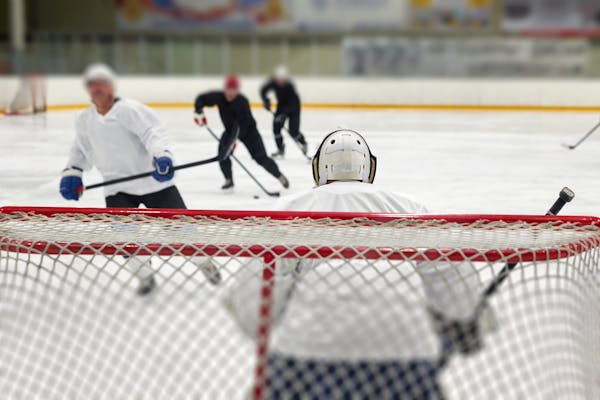
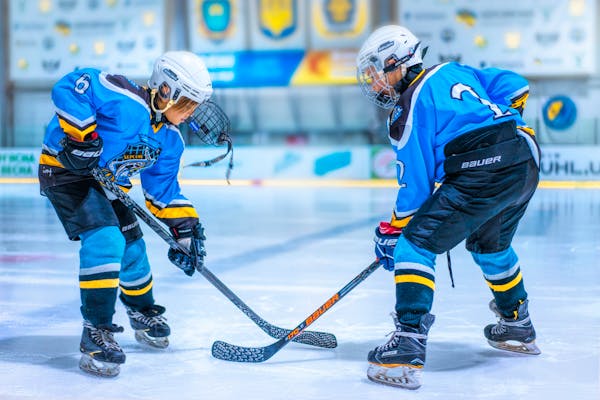
With the new style of hockey, speed has never had more value to coaches, players and parents. Teammates, coaches and spectators all enjoy the thrill of watching a player wheel behind their net, sprint up the ice and create a scoring chance in an end-to-end rush. Yet to excel in the fast pace of hockey, straight ahead speed is complimented by other explosive ingredients. Players must also rely on first step quickness, multi directional movement skills, agility, deceleration, reaction skills and high intensity energy output.
Speed can be trained and improved, and certainly there are fast players and slow players when observed in straight line skating drills. Starting fast and going fast are critical to game success, but hockey requires players to stop and start, quickly moving from point A to B to C with explosive starts and stops. The execution of these complex agility tasks requires aggressive braking, fast direction change and acceleration into the next critical ice position. Deceleration and direction change exposes more player weaknesses where races to loose pucks can be won or lost and game-breaking plays can be created.
Deceleration before acceleration:
Where many hockey training programs market speed and acceleration training for next level success, the secret to speed is found in deceleration skills. Properly trained stopping mechanics can instantly harness explosive power and translate it in an opposite direction.
Poorly trained deceleration skills can lead to injury as the untrained body attempts to absorb great amounts of force. Many players lose energy in direction change which leads to a critical delay in the read-react environment, giving the opponent a distinct advantage. On the defensive side, the goal is to close the gap and take away space and excellent deceleration skills make containing the opponent easy using reactive agility and good positioning.
A progressive approach to training deceleration:
I use the BRAKES training concept to teach and train outstanding decelerations skills. BRAKES stands for Balance, Reaction, Agility, K(Q)uickness, Explosive Speed and Eccentric Strength.
Balance training using unstable surfaces can teach athletes to retain body control in challenging and unpredictable situations similar to game demands. Players then repeat fundamental patterns to improve movement skill efficiency giving definition to general athleticism, and leading to better body control. New movements progress from slow, deliberate actions that require conscious thought to automatic movements that can be done at high speeds. Building and repeating movement patterns develops a fast mind to muscle connection creating “smart muscles” that quickly comply with the brain’s commands. Once well-rehearsed, multi directional movements become intuitive and can be executed using coach’s cues to initiate a direction change forcing players into high pressure decision making.
Remember, you need linear speed to excel in hockey, but when training, the higher the velocity, the greater the risk of injury. Coaches should take the time to teach deceleration mechanics for players to safely handle braking forces and have the ability to generate excellent first step quickness and high-speed agility.
Peter Twist, 11-year NHL Conditioning Coach, is president of Twist Conditioning Inc., a company that provides franchised Sport Conditioning Centres, Smart Muscle™ Hockey training products and home study coach education.
www.twistconditioning.com |