By James Poole, National Sports Development /
As I work with minor hockey players in Calgary, it is rare to find a D-man that truly understands how to play the position. Some players have the physical attributes, some players have the core hockey skills, and some players have a grasp on the mental aspects involved in playing the position – very few players have a combination of all three. Defence could be described as an art and is a very different position than that of forward – as the defenceman is faced with many critical decisions during a game which could make the difference between winning and losing.
How should I handle a 2-on-1 rush?
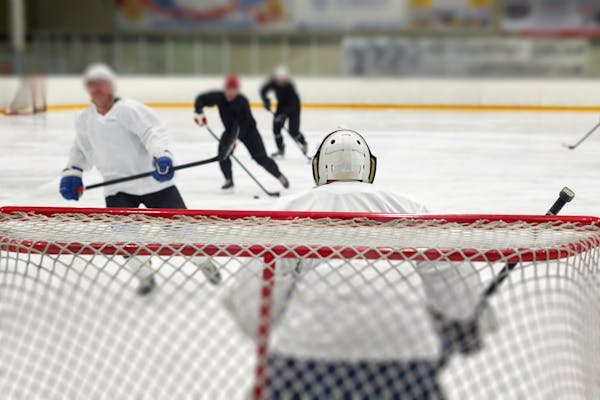
As the 2-on-1 approaches the offensive zone, you will position yourself towards the middle because you want the outside man to carry the puck and eventually take the shot. You are playing the open man in the slot area, preventing the pass, while the goalie has the shooter so it’s easier to think of this as a 2-on-2. Your objective is to run the puck-carrier out of time and end up in the corner of the rink, having to make a forced play or bad angle shot. Don’t forget that the more time you buy, the better the chance that help will be coming in the form of your D partner or a forward.
How do I clear the front of the net without taking a penalty?
The fundamental guideline in this situation is to try to keep the body between the attacker and the net without allowing oneself to be completely tied up. Getting tied up in front of your net is a sure way to tire you out or cause you to take a penalty. Before anything else, the defenceman’s priority is to establish inside positioning and seal the oncoming forward out of the shooting lane, giving the goalie a clear view of the shot. If positioning is up for grabs – you have to play off your opponent with your stick on the ice. At the time when a play must be made (pass or shot by your opponent), turn and get body position with two hands on your stick. Use your legs for leverage and get strong on your stick. Knock the puck to the corner or to a teammate if at all possible. You can pick your spots and hit your opponent below the hips to move him where you want him. Should an opponent have size advantage, you have to be smart and use your stick to knock pucks away. Another trick is to push your knee into the back of your opponent’s knee – it will immediately shift his balance – take advantage of this opportunity to gain control of the situation.
When should I pursue the puck into the corner and when should I stay back?
It is important to size up situations quickly. A defenceman must know that the most important piece of ice is the slot area, as that is where 75 per cent of all goals are scored. Why would a player ever want to leave the front of the net to chase a puck carrier who is behind the goal line or near the boards when no teammate is available to cover the front of the net? It shouldn’t happen, yet it occurs frequently during games at all levels of play. The major reason for this is because players become impatient or are focused only on the puck, unaware of who or what else is around them.
When facing this situation, get your head on a swivel. Look around, and make sure you have backup. Once you know you have support in the front of the net, get your feet moving and take an angle on your opponent and drive him preferably up the wall and away from the net.
To determine how aggressive to pressure the puck carrier, you must read the level of puck possession. If the puck carrier is facing the boards or fumbling the puck, pressure aggressively. If the puck carrier has clean possession and is facing you, take a passive angle trying to contain the player and slowly eliminate his time and space. One forward and one defenceman typically work the corner together but not on the same man – this must be communicated. While in pursuit of the puck-carrier, lead with your stick and finish with your body. Conversely, you should be patient or stay back when you are alone in front of the net and your partner is out of position, has been knocked down, or was beaten out of the corner.
Play the front of the net like a 2-on-1. Do not charge the puck carrier. By being patient, you are buying time for your teammates to recover into support positions. Remember that the key to good defensive play is eliminating scoring opportunities in the prime scoring area and the patience to eliminate time and space from opponents until you can create a turnover.
Being able to react and make correct decisions can make up for physical limitations. Take a look around the NHL and you will see a number of veteran defenceman who are still contributing players to their teams because they make smart decisions and know the tricks of the trade. To learn more about the position, visit www.NSD365.com, as National Sports Development offers a number of clinics and programs that can help develop each player with the mental and physical aspects of the game of hockey.
James Poole is currently Director of Hockey Operations at National Sports Development and Head Hockey Instructor. James also is in his second-year as Head Coach of the Calgary Midget AAA Buffaloes, leading them to the 2008 AMHL and Pacific Regional Championship, and most recently the 2008 Mac’s
Midget Championship. |